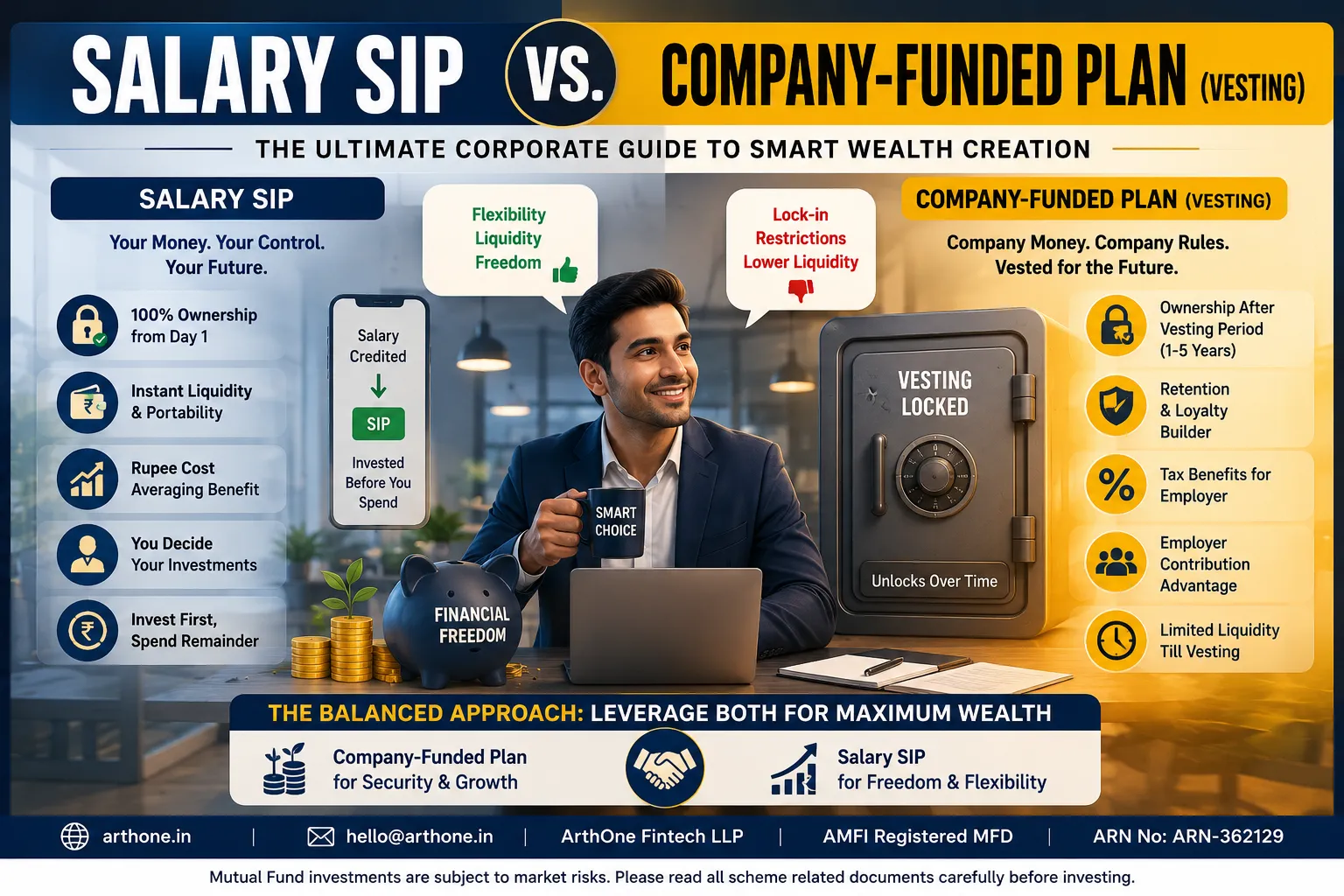
The Ultimate Corporate Guide: Salary SIP vs. Company-Funded Plan (Vesting)
When structuring or evaluating a corporate compensation package, the mechanism chosen for long-term wealth accumulation plays a decisive role in defining financial security. Today, the debate centers on two powerful financial frameworks: the Salary-Linked Systematic Investment Plan (Salary SIP) and the Company-Funded Plan governed by Vesting Schedules (such as Gratuity, National Pension System (NPS) corporate models, or Employee Stock Ownership Plans (ESOPs)).
Understanding the legal structures, strategic benefits, and operational friction of both frameworks allows employers and individuals to optimize wealth creation.
Critical Diagnostic: Define Your Angle First
To extract the maximum value from this guide, you must first clarify your objective by answering these two critical questions:
1. What is your perspective?
- Employer's Implementation Perspective: You want to design a benefits package that acts as "golden handcuffs" to retain top talent, optimize corporate tax outgo, and maintain zero balance-sheet liability.
- Employee's Wealth Perspective: You want to minimize career lock-in, eliminate behavioral spending leakage, maximize your take-home tax-free wealth, and ensure 100% asset portability when changing jobs.
2. Which specific company plan are you comparing against?
- Gratuity: Statutory retirement benefit linked to tenure (usually 5 years) and final drawn salary.
- Corporate NPS: Co-contributory pension model with tier-1 locked funds and dedicated tax benefits under Section 80CCD(2).
- ESOPs (Employee Stock Ownership Plans): Performance or time-linked corporate equity grants that offer massive upside but come with high asset concentration risk.
1. Foundation: Core Definitions
What is a Salary SIP?
A Salary SIP is a payroll-linked investment mechanism that automatically reroutes a fixed portion of an employee's salary into market-linked mutual funds before the remaining income hits their bank account.
Historically, mutual funds strictly required investments to originate directly from an individual's personal bank account to prevent money laundering. However, modern regulatory frameworks allow registered companies to act as secure financial pipelines. This shifts the savings order from Earn -> Spend -> Invest what is left to Earn -> Invest via Payroll -> Spend the remainder.
What is a Company-Funded Plan with Vesting?
A Company-Funded Plan is a corporate retirement or retention benefit where the employer allocates capital on behalf of the employee, but the employee does not gain ownership of those assets until specific milestones are met.
This milestone process is known as vesting, which can be:
- Time-based: Requiring a set number of years of continuous service.
- Performance-based: Tied to achieving corporate milestones or targets.
If an employee exits the organization prior to completing the vesting schedule, the unvested assets are permanently forfeited back to the company.
2. Deep Dive: Key Technical and Legal Features
The legal architecture dictates who controls the money, who absorbs the risk, and what happens when an employee decides to switch jobs.
Ownership and Portability
- Salary SIP: The employee maintains 100% legal ownership of every mutual fund unit from day one. The company acts purely as a transactional conduit. If the employee resigns, the accumulated portfolio remains entirely unaffected. The individual can seamlessly convert the plan into a regular personal SIP or link it to a future employer's payroll system.
- Company-Funded Plan: Ownership is conditional. For statutory corporate benefits like Gratuity under the Payment of Gratuity Act, permanent employees must hit a mandatory 5-year continuous service milestone to vest. However, under modern labour codes, fixed-term contract employees can vest on a pro-rata basis after just 1 year of service. For corporate equity plans like ESOPs, companies typically deploy a graded vesting schedule (e.g., 25% vesting annually over 4 years).
Asset Allocation and Investment Risk
- Salary SIP: The investment risk is borne entirely by the individual employee, as capital is exposed directly to market-linked equity or debt mutual funds. Employees enjoy complete autonomy to choose their asset allocation based on their risk tolerance.
- Company-Funded Plan: The risk profile depends on the chosen vehicle. In defined-benefit structures like Gratuity, the employer carries the financial liability and must pay out a fixed formula regardless of corporate performance. In corporate NPS structures, funds are managed by licensed Pension Fund Managers across corporate, equity, and government debt pools. For ESOPs, the asset risk is highly concentrated within the employer's own corporate equity performance.
3. Benefits Analysis: Company vs. Individual
For the Individual Employee
Salary SIP Benefits
- Elimination of Behavioral Leakage: Automatically investing capital prior to bank account delivery removes human error and the temptation to spend disposable income.
- Rupee-Cost Averaging: Regular monthly market purchasing averages out asset entry costs during market corrections.
- Instant Liquidity: Assets can be redeemed directly into the employee's personal verified bank account at any time, completely bypassing the employer's administrative framework.
Company-Funded Plan Benefits
- Forced Wealth Preservation: Strict vesting timelines prevent early emotional asset liquidations, ensuring a substantial retirement nest egg.
- Subsidized Capital: Corporate contributions act as an effective compensation top-up on top of base take-home wages.
For the Corporate Employer
Salary SIP Benefits
- Zero Liability Infrastructure: Employers face no long-term balance-sheet liabilities, as fund accumulation is fueled directly by employee salary allocations.
- Minimal Administrative Overhead: Modern automated payroll platforms manage updates and transaction routing without taxing corporate HR teams.
Company-Funded Plan Benefits
- Talent Retention Engineering: Vesting schedules create "golden handcuffs" that disincentivize key employees from jumping to competitors mid-cycle.
- Corporate Tax Deductions: Employer contributions made toward approved gratuity funds or corporate pension accounts are deductible as business expenses under prevailing income tax statutes.
4. Side-by-Side Comparison
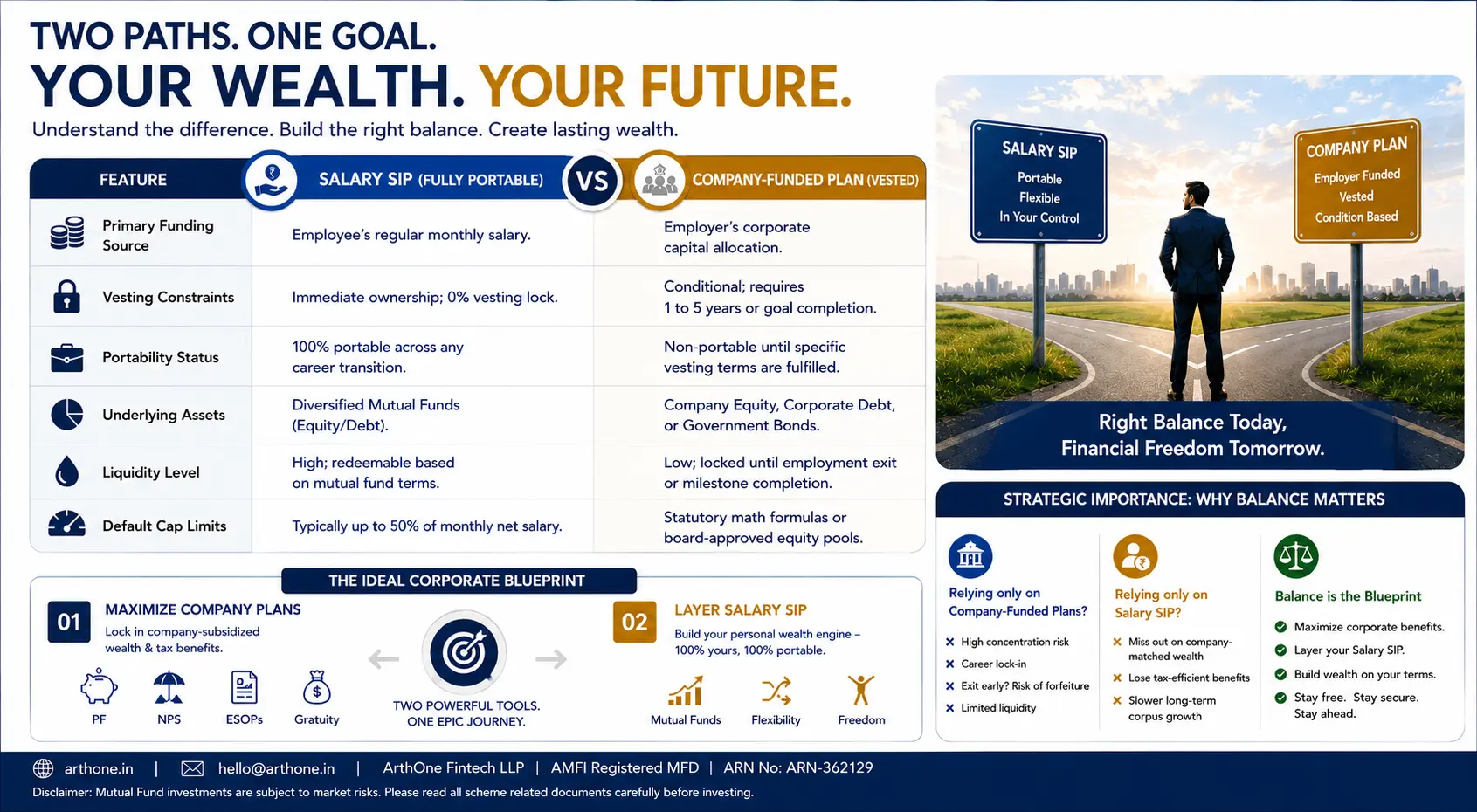
5. Strategic Importance: Why Balance Matters
Relying exclusively on one system creates structural weaknesses in a personal financial blueprint.
An individual backed only by Company-Funded Plans faces high concentration risk and career lock-in. If you need to exit a toxic work environment or pivot your career before hitting a cliff milestone, you face severe capital forfeiture.
Conversely, relying solely on a Salary SIP means missing out on employer-matched retirement contributions and tax efficiencies designed for corporate long-term structures.
The Ideal Corporate Blueprint
For optimal financial health, treat these mechanisms as complementary layers:
- Maximize mandatory or matched corporate accounts first to lock in company-subsidized wealth.
- Layer an automated, voluntary Salary SIP on top to guarantee consistent personal wealth compounding that remains entirely under your control.
About the Author