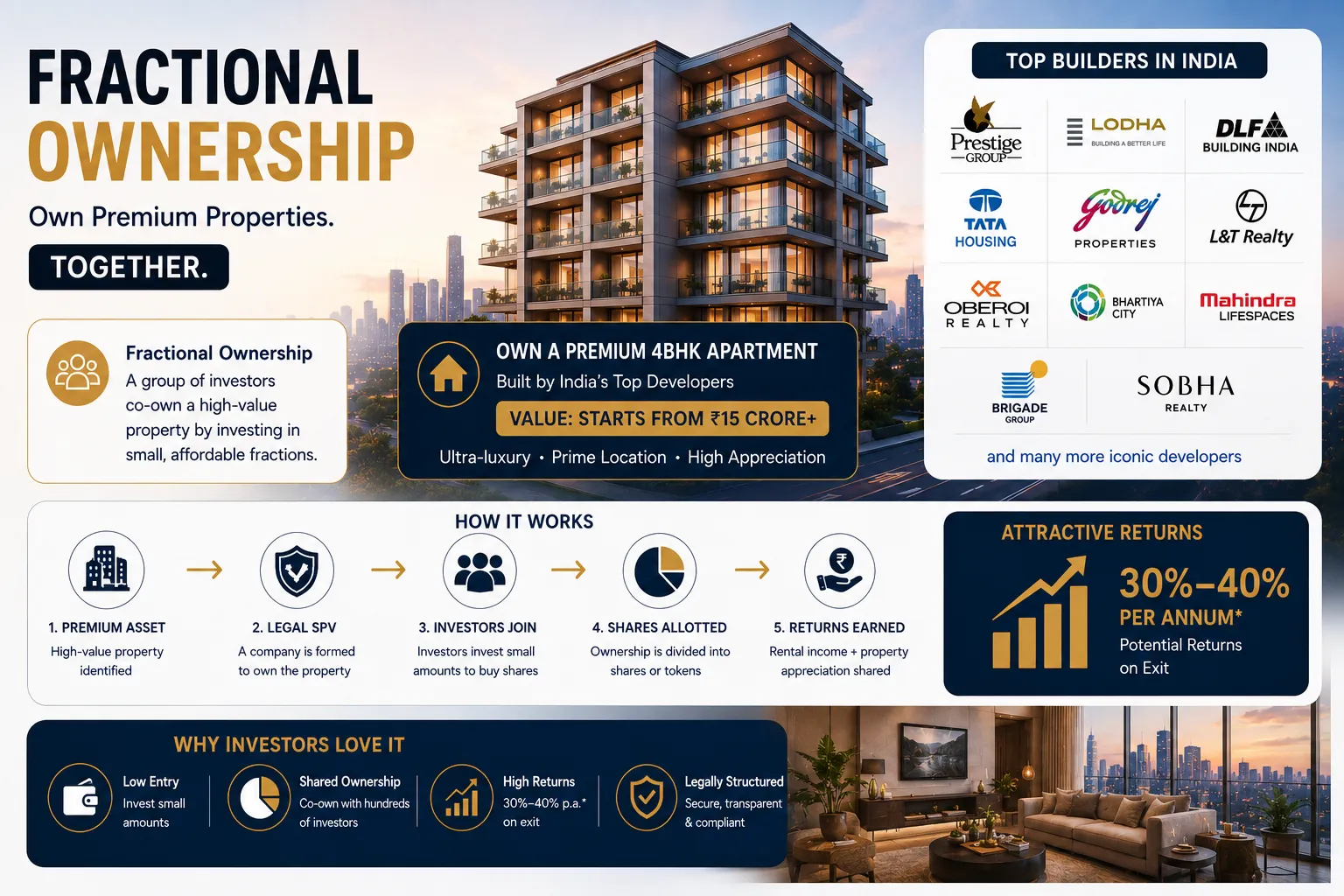
For decades, premium Indian real estate was an exclusive playground for the ultra-wealthy. If you wanted a piece of a luxury high-rise apartment in a top-tier city, you needed a massive bank account, complex legal assistance, and multi-crore budgets.
The game has completely changed. Thanks to Fractional Real Estate Investment and Tokenization, the middle class can now own a piece of India's most luxurious, ₹10 Crore+ premium flats with small ticket sizes of just ₹5 Lakh to ₹10 Lakh. By leveraging high rental yields, early-stage capital appreciation, and bulk exit strategies, everyday investors are pulling in 30% to 40% cumulative annual profit margins when these premium properties are resold.
Let's break down this revolutionary investment model with deep facts, figures, city data, and risk mitigation strategies.
>> Understanding Fractional Real Estate: How Multiple People Buy One Property :
Fractional ownership simply means "fractional malkiyat" or shared ownership. Instead of buying an entire property alone, a group of unrelated investors pools their money to co-own a highly valuable asset that they couldn't afford individually.
Imagine an ultra-luxury 4BHK apartment built by a legendary developer in a prime area, priced at ₹10 Crore. A fractional investment platform divides this ₹10 Crore asset into smaller, accessible fractions.
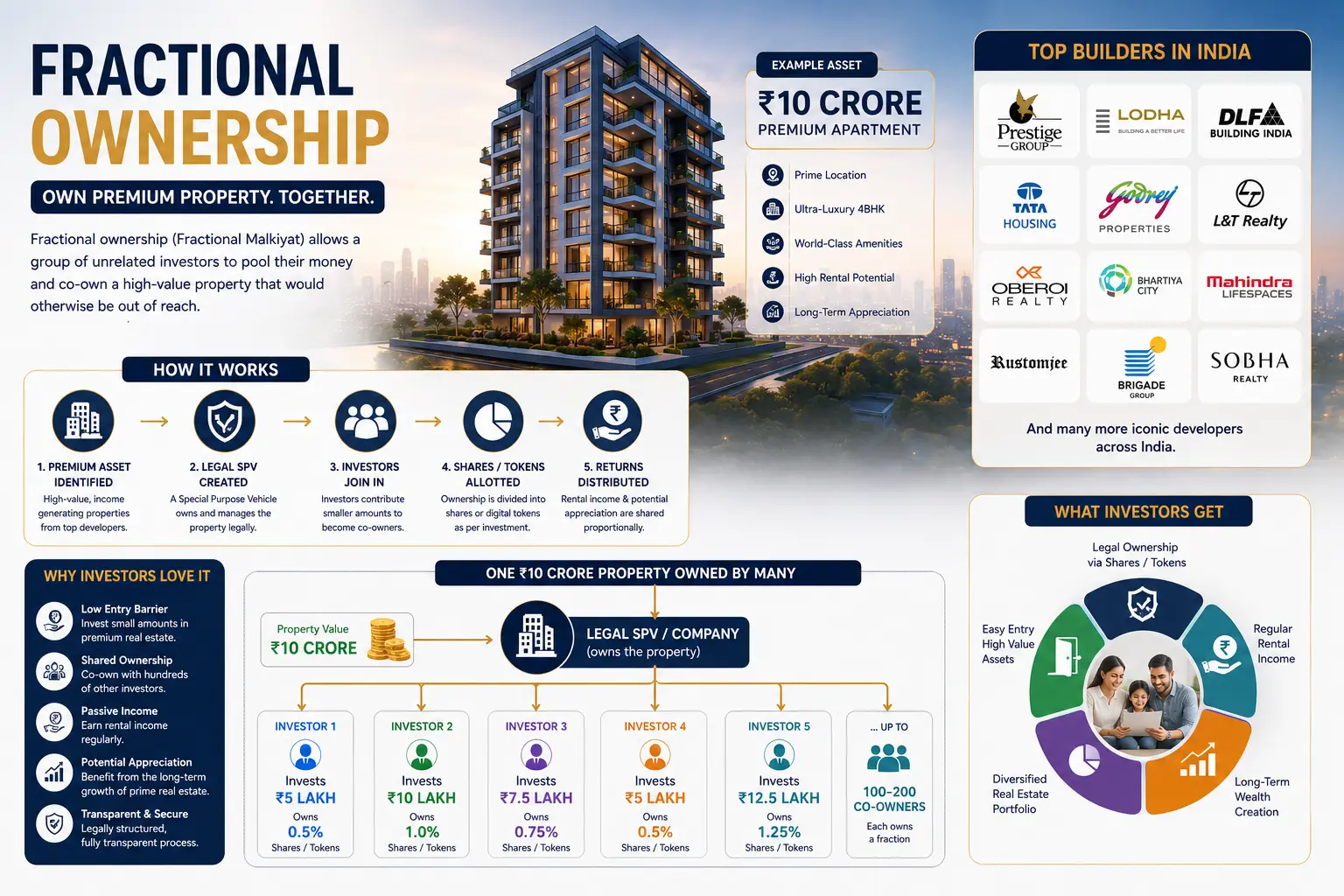
- The SPV Structure: The investment platform creates a specific, government-registered company called an SPV (Special Purpose Vehicle) just for that one ₹10 Crore flat.
- True Legal Ownership: When you invest your ₹5 Lakh or ₹10 Lakh, you are buying direct shares in that specific company. Because the company owns 100% of the flat, you legally own a direct piece of the real estate.
- The Collective Sale: When the property value appreciates by 30% to 40% after a few years, the platform or a majority vote of the co-owners decides to sell the entire flat. The buyer pays the SPV, and the money is distributed straight to your bank account based on your share percentage.
1 Fractional Ownership vs. Tokenization: What is the Difference? ?
While both allow you to invest with small amounts like ₹5 Lakh, they use different systems to manage your shares:
- Fractional Ownership (Traditional Digital Real Estate): Your ownership is recorded in traditional government company registries (RoC - Registrar of Companies). You get a share certificate proving you own a piece of the property.
- Tokenization (Blockchain Real Estate): This takes fractional ownership to the next digital level. Your share certificate is converted into a digital token (like a digital coin) on a secure ledger.
Why Tokenization is Becoming Popular:
- Instant Resale (High Liquidity): In traditional real estate, selling a flat takes months. With tokenization, if you invest ₹5 Lakh today and need cash next year, you can sell your "property tokens" to another investor on the platform's digital marketplace in just a few clicks.
- Fractional Payouts: The rental income generated by the premium corporate tenant is automatically split and sent to your digital wallet or bank account as per the tokens you hold.
How 30% to 40% Annual Profit Margins Are Achieved
Earning a 30% to 40% margin per year on prime real estate sounds impossible to traditional investors who only look at standard 5% residential growth. However, fractional platforms use institutional strategies to maximize returns:
- Pre-Launch & Distressed Deep Discounts: Platforms do not buy properties at retail market prices. They buy in bulk directly from builders during soft launches, pre-launches, or cash-crunch periods. A property worth ₹10 Crore is often acquired for ₹8 Crore, giving investors a built-in 20% profit cushion on day one.
- Corporate Premium Leases: Luxury residential apartments in prime hubs are frequently leased out to Fortune 500 CEOs, expat executives, or MNC guest houses. These entities pay premium rents that far exceed standard market rates.
- Compounding Hyper-Appreciation: Prime land in major metros is extremely scarce. As the surrounding infrastructure grows, property values in these exact micro-markets appreciate rapidly.
- The Strategic Institutional Exit: Platforms typically hold the property for 2 to 3 years. Once the micro-market hits peak demand, the platform bundles these assets and sells them to institutional buyers, NRI pools, or high-net-worth individuals (HNIs). The combination of the initial deep buying discount, 3 years of accumulated rental yield, and explosive compounding appreciation results in an exit margin of 30% to 40% per year for early fraction holders.
To understand where this explosive growth happens, we must look at the specific micro-markets where premium flats routinely cost ₹10 Crore to ₹30 Crore+.

Eliminating Risk: Highly Reputed Builders
The biggest fear in traditional real estate is the project getting stuck, delayed, or legally challenged. Fractional platforms completely bypass this risk by investing only in projects built by India's absolute finest tier-1 developers.
When you invest in properties constructed by legendary names, your risk drops to near zero:
- Godrej Properties: Known for impeccable corporate governance, timely deliveries, and cutting-edge luxury townships across Gurgaon, Mumbai, and Pune.
- L&T Realty (Larsen & Toubro): The engineering giant brings unmatched structural quality, massive financial backing, and zero risk of project abandonment.
- DLF: The undisputed king of luxury real estate on Gurgaon's Golf Course Road (creators of iconic properties like The Camellias, where flats fetch over ₹50-100 Crore).
- Prestige Group & Brigade Group: The dominant forces in Bangalore and Hyderabad, celebrated for flawless premium executions and high tenant retention rates.

: 1 Property vs. 10 Properties: The Ultimate Diversification Strategy :
Consider the old-school investment model. You save ₹50 Lakh and use it as a down payment to buy a single, mid-tier 2BHK suburban flat worth ₹1 Crore, taking on a massive 20-year home loan. If that specific neighborhood stagnates, or if your tenant leaves, your entire net worth is stuck in a low-yielding asset.
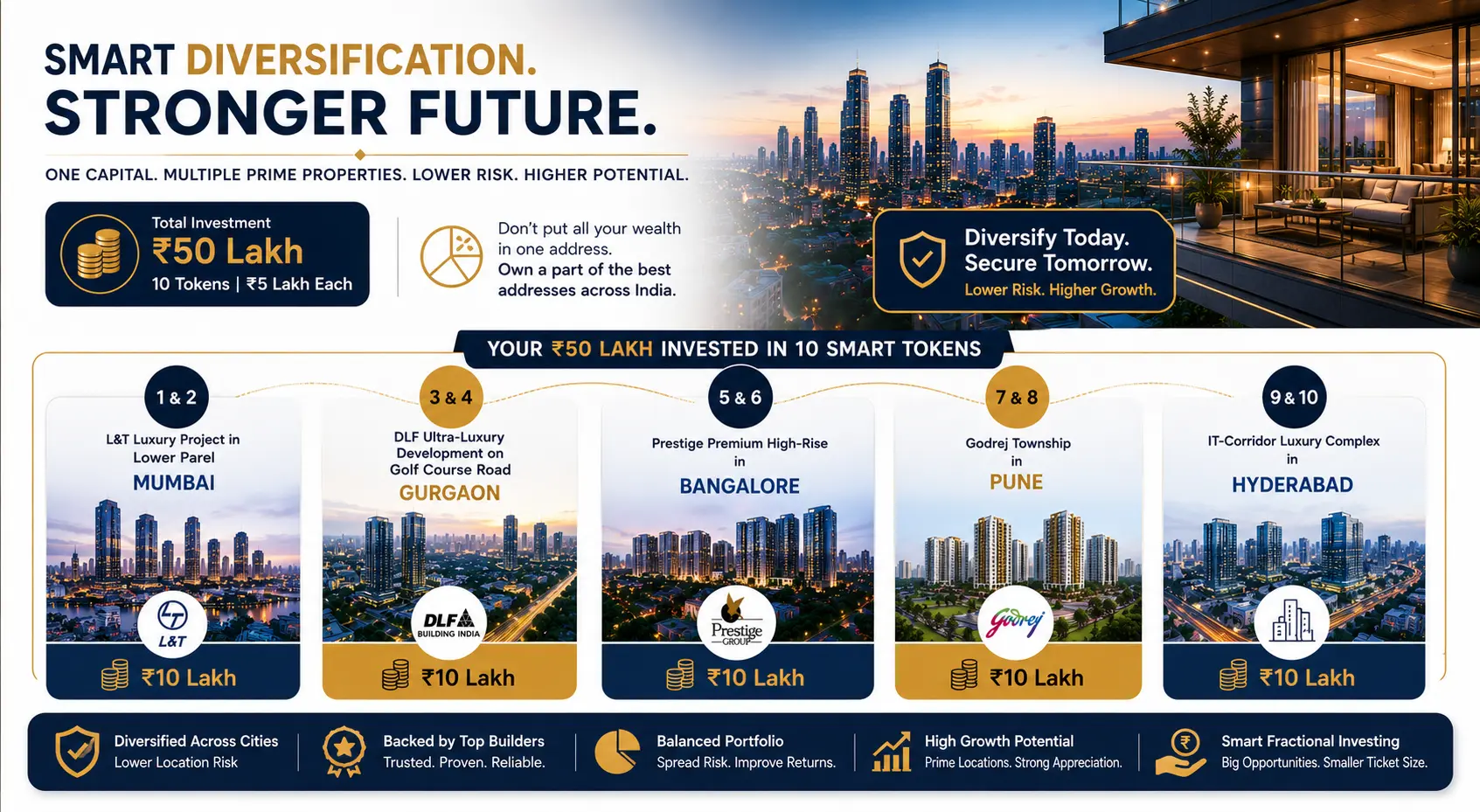
Fractional investing unlocks a Smart Diversification Blueprint. Instead of locking ₹50 Lakh into one single property, you split that capital into 10 separate tokens of ₹5 Lakh across multiple prime cities:
- Tokens 1 & 2: Put ₹10 Lakh into an L&T luxury project in Lower Parel, Mumbai.
- Tokens 3 & 4: Put ₹10 Lakh into a DLF ultra-luxury development on Golf Course Road, Gurgaon.
- Tokens 5 & 6: Put ₹10 Lakh into a Prestige premium high-rise in Bangalore.
- Tokens 7 & 8: Put ₹10 Lakh into a Godrej township in Pune.
- Tokens 9 & 10: Put ₹10 Lakh into an IT-corridor luxury complex in Hyderabad.
The Result: You now hold diversified ownership in ₹100 Crore worth of combined prime real estate portfolio. If one city's IT sector slows down temporarily, the explosive growth in Gurgaon or Mumbai completely covers it. Your risk is fully hedged, your cash flow is highly stabilized, and you avoid the multi-decade trap of a heavy bank loan.
: Why Early Investment is a Superpower :
Real estate wealth is heavily dependent on time. Entering the premium market early in your career provides distinct financial advantages:
- Compounding Over Time: A property appreciating at 15% compounded annually doubles in value roughly every 4.8 years. The younger you start investing, the more doubling cycles your capital goes through.
- Inflation Protection: Cash kept in bank accounts or standard fixed deposits loses value to inflation. Premium real estate values naturally rise alongside inflation, fully protecting your purchasing power.
- Passive Cash Generation: Starting early creates a steady stream of monthly passive rental income that can be reinvested into other asset classes.
: Why You Should Invest through ArthOne: Institutional Power vs. Individual Limitations :
When you buy a property on your own, you are forced to do all the heavy lifting: checking land titles, predicting city masterplans, negotiating with builders, and managing difficult tenants. This is exactly where ArthOne completely transforms the investment experience.
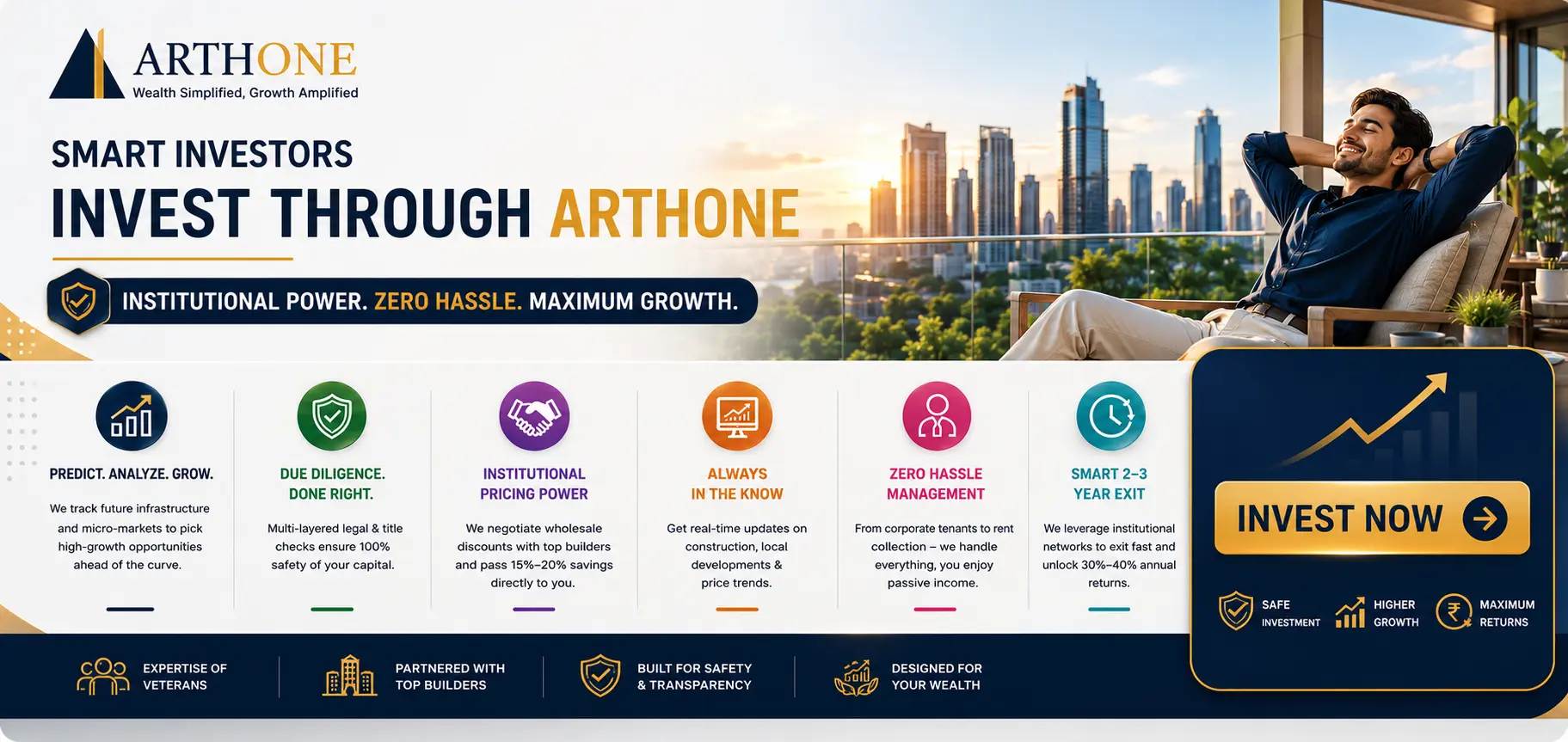
ArthOne and its elite partner ecosystem bring together a team of real estate veterans with decades of combined institutional experience. They execute deep, microscopic research that is practically impossible for an individual retail investor to perform alone.
Here is how ArthOne's specialized expertise protects your capital and guarantees maximum growth while you sit back and relax:
- Micro-Market Predictive Analytics: While a regular buyer only looks at current market rates, ArthOne’s team deeply analyzes future infrastructure pipelines. They track upcoming metro lines, expressway extensions, and commercial tech parks years before they are built, picking properties right at the inflection point of explosive growth.
- Flawless Due Diligence & Fraud Protection: Individual buyers are highly vulnerable to title fraud or hidden legal disputes. ArthOne's legal and compliance experts run rigorous, multi-layered title checks, verifying RERA approvals, land clearings, and financial health profiles of top builders like L&T and Godrej.
- Institutional Pricing Power: Because ArthOne pools massive capital from thousands of investors, they don't buy at retail rates. They negotiate massive wholesale discounts directly with developers, passing those immediate 15% to 20% savings straight to your tokens. An individual walking into a builder's office could never secure these institutional price drops.
- Continuous Development Tracking: Once you invest, you don't have to worry about a thing. The platform provides continuous digital updates on every single local development, construction milestone, and micro-market price trend.
- Zero-Hassle Corporate Tenant Management: Finding a high-paying corporate tenant or expat executive, handling legal lease agreements, and chasing monthly rent is an exhausting job. ArthOne's partner companies manage 100% of the property operations, ensuring your passive rental income drops into your account like clockwork.
- The Smart 2-to-3-Year Exit Strategy: An individual investor often struggles to sell a ₹10 Crore asset quickly. ArthOne utilizes its deep institutional networks, bundling the asset and selling it to large global funds, HNIs, or NRI pools within a tight lock-in window of just 2 to 3 years. This optimized exit is what unlocks that spectacular 30% to 40% return per year, completely freeing you from the stress of day-to-day management.
With ArthOne, you stop acting like a stressed landlord and start behaving like a smart institutional investor—just invest, track your asset digitally, and relax.
: Seamless Alternative Investing Through ArthOne :
To execute this modern style of wealth creation, digital wealth management platforms have completely streamlined alternative investments. Platforms like ArthOne serve as multi-product financial ecosystems, giving everyday investors direct access to highly curated, safe, and high-yield alternative assets.
By eliminating complex paperwork and massive entry barriers, ArthOne lets you manage your alternative portfolio digitally:
- Browse Curated High-Yield Assets: Review heavily vetted alternative real estate models and high-growth asset classes directly on the platform.
- Digital Verification: Complete your paperless KYC quickly using your PAN, Aadhaar, and bank details.
- Micro-Allocation: Start small with tokens ranging from ₹5 Lakh to ₹10 Lakh and allocate your funds across different premium alternative choices without needing crores of rupees.
- Track Performance: Monitor your monthly yields, asset health, and estimated capital appreciation through a clear, unified digital dashboard.
Conclusion
You no longer need to look at luxury high-rises in Gurgaon or Mumbai and think, "That's only for billionaires." Tokenized fractional investing has democratized luxury real estate. By shifting your strategy from a single, high-liability suburban home loan to diversified fractions of ₹10 Crore+ premium properties built by trusted corporate giants like Godrej and L&T, you can consistently unlock institutional-grade 30% to 40% annual margins.
Would you like me to map out a specific ₹5 Lakh token allocation example showing the estimated monthly rental payout vs. the final resale payout? Let me know if you want to focus on a particular city like Gurgaon or Mumbai!

About the Author
Raj Santra is an Indian corporate business leader, fintech expert, technologist, and author. He specializes in bridging the gap between academic theory and real-world industrial corporate practices through educational technology and search automation.