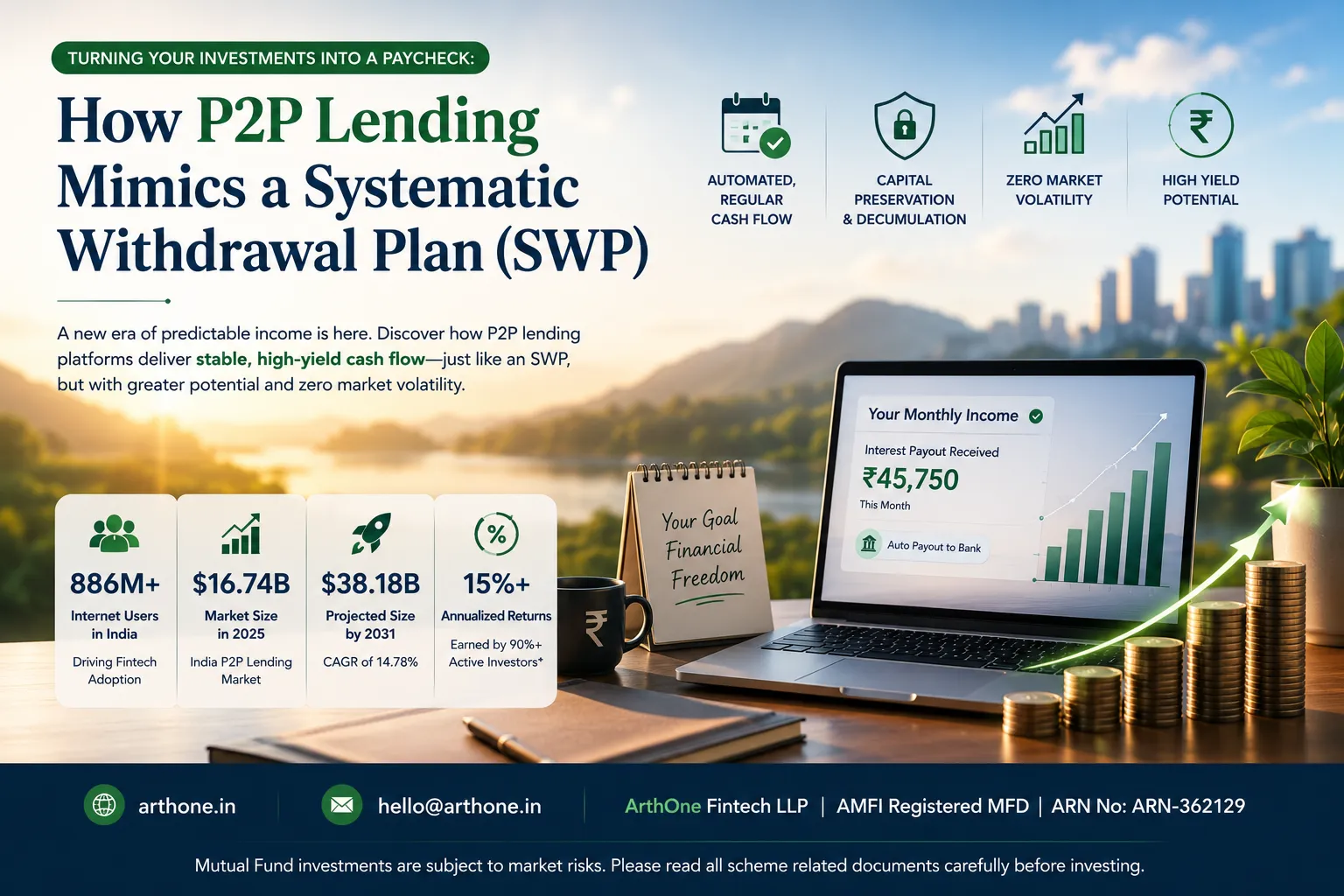
Many investors build wealth only to face a new challenge: how to safely spend it. For decades, the standard answer for generating regular income has been the Systematic Withdrawal Plan (SWP) through mutual funds.
However, a new contender has emerged in the digital age. Driven by India's 886 million internet users and a booming fintech ecosystem, the India P2P Lending Market has reached a valuation of USD 16.74 Billion in 2025 and is projected to expand rapidly at a CAGR of 14.78% to hit USD 38.18 Billion by 2031. Savvy investors are increasingly utilizing these Peer-to-Peer (P2P) lending platforms to mimic the predictable, steady cash flow of a traditional SWP.
Here is how P2P lending functions like an SWP, the data backing its rise, and how they stack up side-by-side.
The Basics: What Are We Comparing?
Before diving into the similarities, let us briefly define both mechanisms.
- Systematic Withdrawal Plan (SWP): A strategy where you invest a lump sum into a mutual fund and automatically redeem a fixed amount of money at regular intervals (monthly, quarterly, etc.).
- Peer-to-Peer (P2P) Lending: A financial technology platform that matches individuals who want to lend money with vetted borrowers who need unsecured loans.
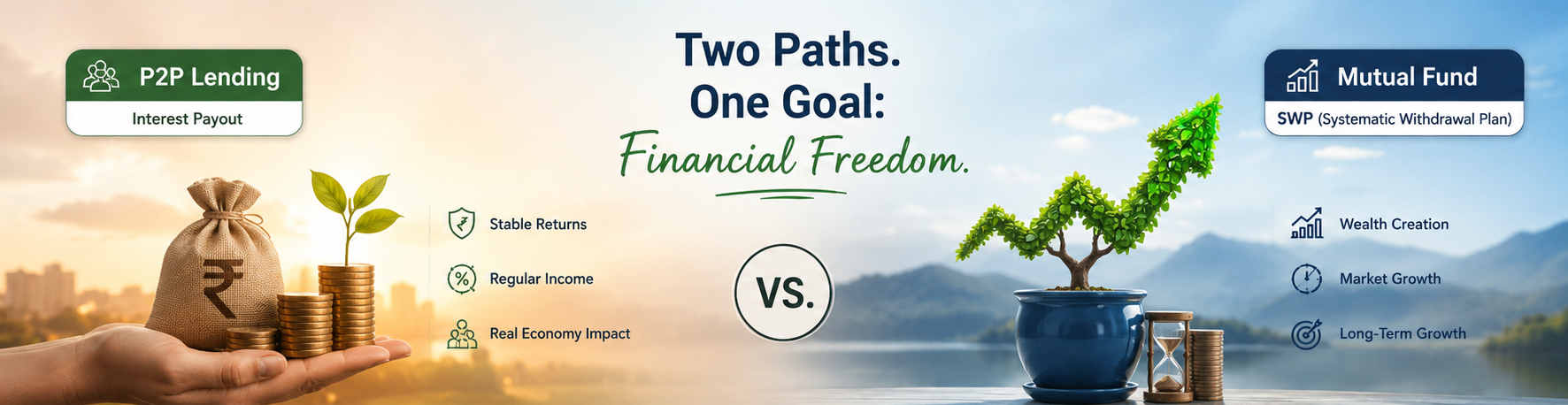
1. Automated, Regular Cash Flow
The primary appeal of an SWP is predictability. You know exactly when the money will hit your bank account every month.
Modern P2P lending platforms offer automated reinvestment and withdrawal features that replicate this experience perfectly. When you lend money, borrowers repay you via Equated Monthly Instalments (EMIs). These EMIs consist of both principal and interest. You can configure your P2P account to automatically transfer these monthly interest payouts directly to your bank account, creating a seamless monthly paycheck.
2. Capital Preservation and De-cumulation
In a standard SWP, your monthly payouts are carved out of your total corpus. If your investments grow faster than you withdraw, your capital remains intact or grows.
P2P lending structures offer a very similar dynamic:
- Interest-Only Withdrawals: You can choose to withdraw only the interest generated by your loan portfolio, leaving your initial principal completely untouched to keep generating returns.
- Structured Principal Repayment: If you want to systematically wind down your investment (similar to consuming your mutual fund units), you can stop auto-reinvesting and let both the principal and interest flow back into your bank account as the loans mature.
3. Mitigating Market Volatility
One of the biggest risks of a traditional SWP in equity mutual funds is Sequence of Returns Risk. If the stock market crashes early in your retirement, you are forced to sell mutual fund units at a loss to sustain your monthly income, which can permanently damage your portfolio.
P2P lending eliminates this specific risk because it is completely decoupled from the stock market. Your returns are tied to fixed-rate loan agreements. Whether the stock market booms or crashes, your borrower’s monthly EMI remains exactly the same, providing a stable anchor for your income needs.
4. High Yield Potential
To get a meaningful monthly payout from a traditional conservative SWP (like debt mutual funds), you often have to accept lower yields. According to market trends, modern short-term debt funds and fixed deposits generally offer around 6% to 7.5% annual returns.
P2P lending cuts out the institutional middleman (the bank), allowing lenders to capture higher yields directly. Leading RBI-regulated NBFC-P2P platforms in India report that over 90% of active investors earn more than 15% annualized returns by diversifying their funds across hundreds of fractional, vetted profiles.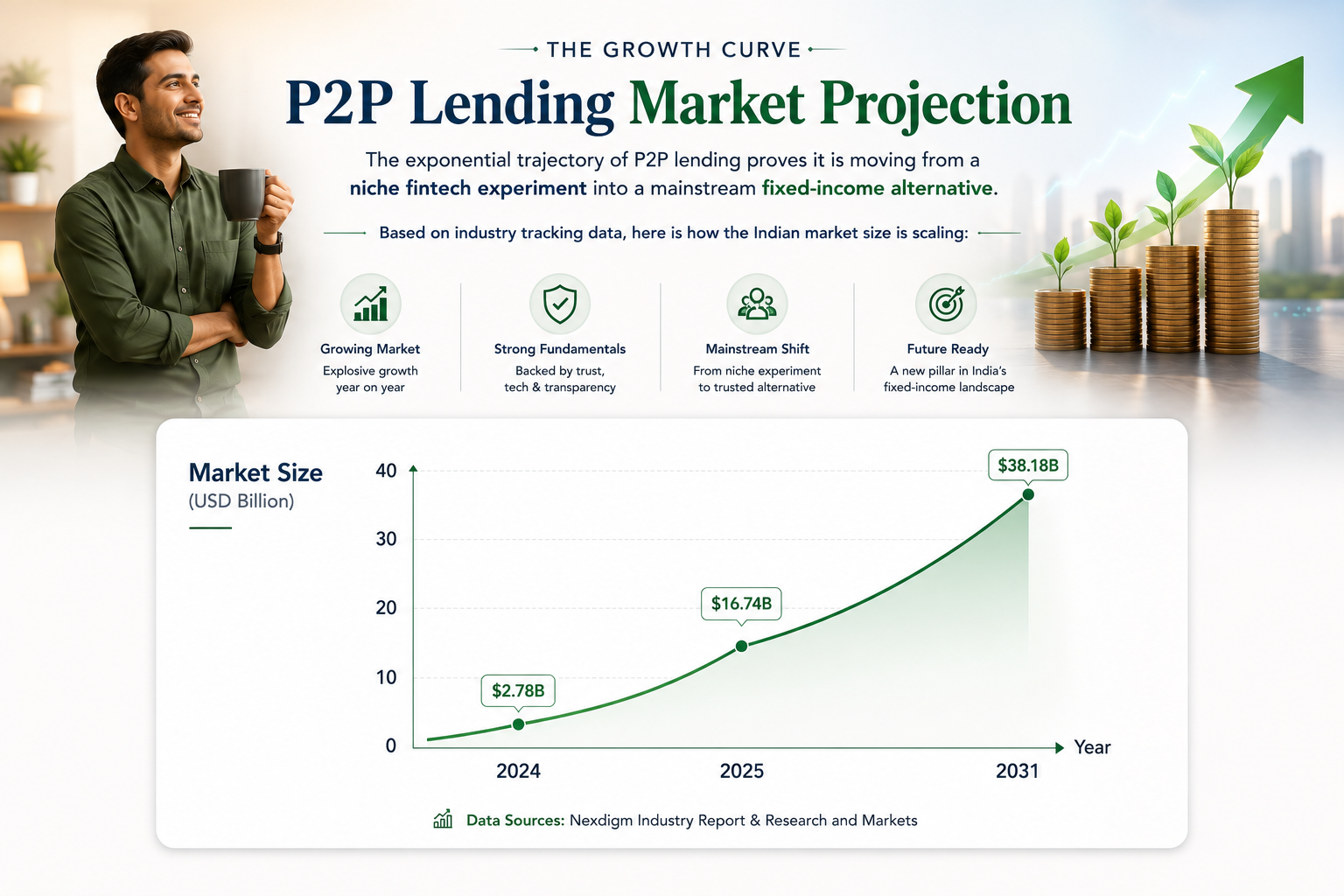
inside the Numbers: Fascinating Realities of the P2P Sub-Asset Class
Before evaluating the structural differences, wealth managers must understand three unique operational mechanisms that define this market:
- The "Reverse Bank" Arbitrage Yield: In a traditional banking setup, depositors earn 3%–7% while the bank lends that same money to retail credit card or personal loan borrowers at 18%–36% APR. P2P platforms eliminate this balance-sheet layer. By acting as a pure-play matching engine, they charge a nominal 1%–2% platform fee and pass the massive 12% to 15%+ net interest margin directly to the asset allocator.
- The Power of Extreme Micro-Fractionalization: Unlike traditional corporate debt where minimum ticket sizes run into lakhs, P2P technology hyper-fragments risk. An allocation of ₹5,000,000 can be algorithmically divided into ₹1,000 notes across 5,000 individual, unrelated retail borrowers. This non-correlated structure means a single default impacts only 0.02% of the active portfolio, providing a statistical buffer that equity-linked instruments cannot match.
- The Credit Risk Swap: While a mutual fund SWP exposes an investor to macro market risks (liquidity crises, interest rate hikes, or corporate governance failures), P2P lending swaps this for granular, micro-level credit risk. By trading systemic market beta for non-systemic credit defaults, it provides a powerful diversification layer for an overall family office or retirement portfolio.
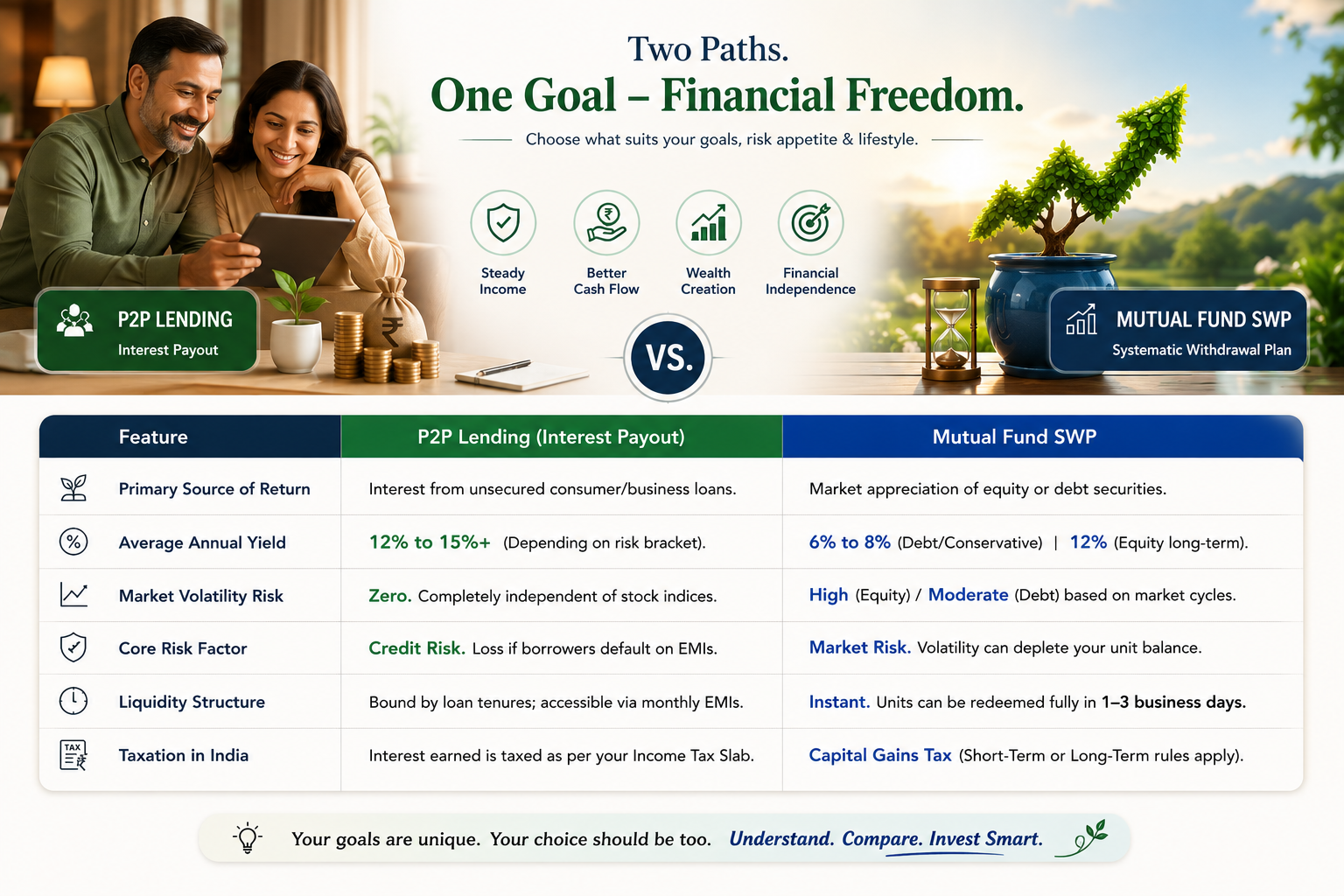 The Crucial Differences to Keep in Mind
While the cash flow experience of P2P lending mimics an SWP, the underlying risk profiles require careful management:
- Diversification is Mandatory: To shield yourself from borrower default risk, you must never lend a massive sum to a single person. Top platforms automatically spread an investment of ₹2 Lakhs across 200+ distinct borrowers to neutralize the impact of individual defaults.
- Liquidity Lockdown: Mutual funds can be liquidated rapidly. With P2P, your money is tied up in active loan durations. You rely strictly on the monthly inward cash flow rather than pulling your entire principal out instantly.
Regulatory Framework: The RBI Guardrails Building Investor Trust
The Reserve Bank of India (RBI) tightly regulates the P2P space under its NBFC-P2P (Peer-to-Peer Lending Platform) Directions. These guidelines protect lender capital through strict compliance layers:
- Cap on Aggregate Exposure: To mitigate systemic concentration risk, a single lender cannot allocate more than ₹50 Lakhs across all P2P platforms combined. Allocations above ₹10 Lakhs require a net-worth certificate issued by a practicing Chartered Accountant.
- Per-Borrower Lending Cap: A lender can expose a maximum of ₹50,000 to any single borrower, legally forcing the asset fragmentation described above.
- Mandatory Escrow Accounts: Platforms cannot hold investor capital on their balance sheets. All funds flow through a dual-trustee escrow account structure (one for fund utilization and one for repayments) managed by an independent bank trustee. This guarantees your money is never co-mingled with operational platform cash.
- No Promised Returns: Under RBI mandates, P2P platforms operate strictly as intermediaries. They are prohibited from guaranteeing fixed assured returns or offering credit guarantees, ensuring transparency in credit risk reporting.

The Verdict
If you love the automated, hands-off nature of a Systematic Withdrawal Plan but want to protect a portion of your income portfolio from stock market swings, P2P lending acts as an excellent alternative income generator. By instructing your platform to pay out monthly earnings directly to your bank, you can achieve a stable, high-yield cash flow.
About the Author