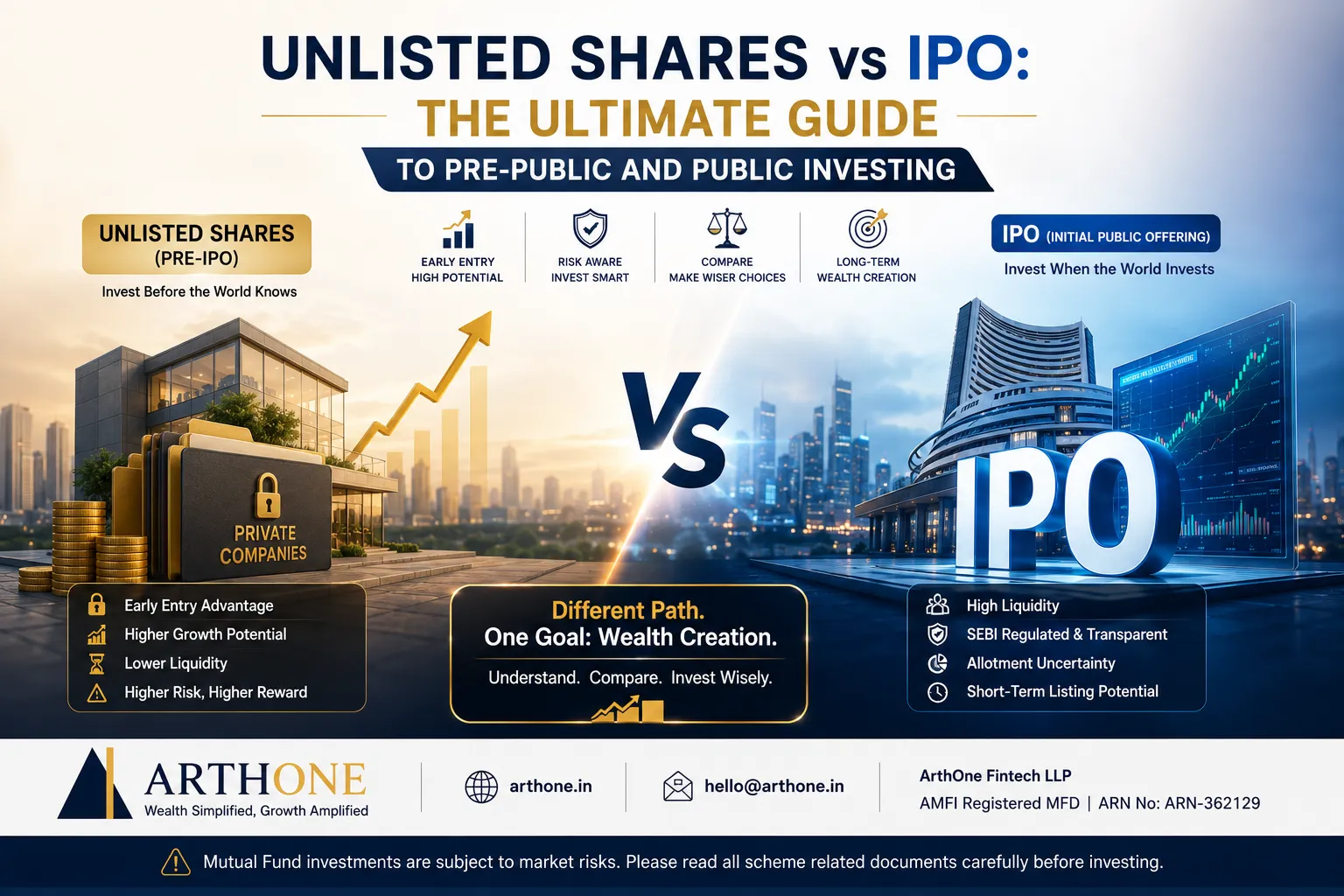
Unlisted Shares vs IPO: The Ultimate Guide to Pre-Public and Public Investing
Investors seeking outsized returns often look beyond standard stock exchanges. Two prominent avenues for capturing early-to-mid-stage company growth are unlisted shares and Initial Public Offerings (IPOs). While both allow you to own a piece of a company, they operate in entirely different regulatory, liquidity, and risk ecosystems.
The core difference lies in their market maturity: unlisted shares represent investments in private companies before they list publicly, whereas an IPO is the exact transition point where a company lists on a public stock exchange.
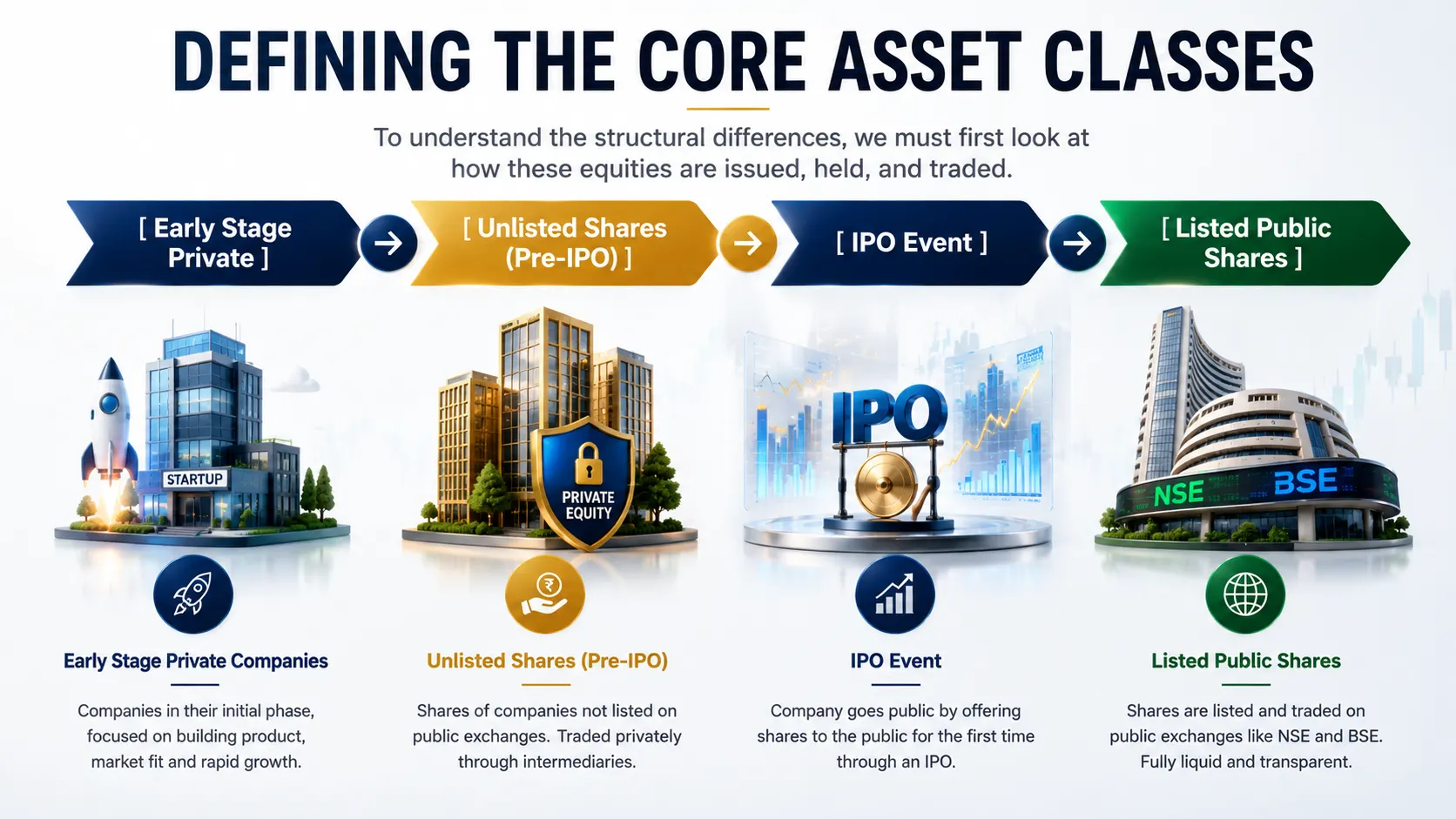
1. Defining the Core Asset Classes
What are Unlisted Shares?
Unlisted shares belong to companies not traded on official public stock exchanges like the National Stock Exchange (NSE) or Bombay Stock Exchange (BSE).
- Trading Mechanism: Transactions occur Over-The-Counter (OTC) through specialized intermediaries, dealers, or peer-to-peer networks.
- Target Companies: These include late-stage startups, subsidiaries of large conglomerates waiting to list, or established businesses that prefer to remain private.
- Key Drivers: Investors buy these to capture value before institutional public bidding drives up the price.

What is an Initial Public Offering (IPO)?
An IPO is the formal process where a private corporation offers its shares to the public for the first time to raise capital.
- Trading Mechanism: Shares are applied for through a structured bidding window via commercial banks and brokers, then trade openly on public exchanges.
- Target Companies: Typically mature businesses that meet strict regulatory financial thresholds and require massive capital for expansion or to provide an exit for early investors.
- Key Drivers: Investors participate to benefit from potential listing-day gains and long-term public market liquidity.
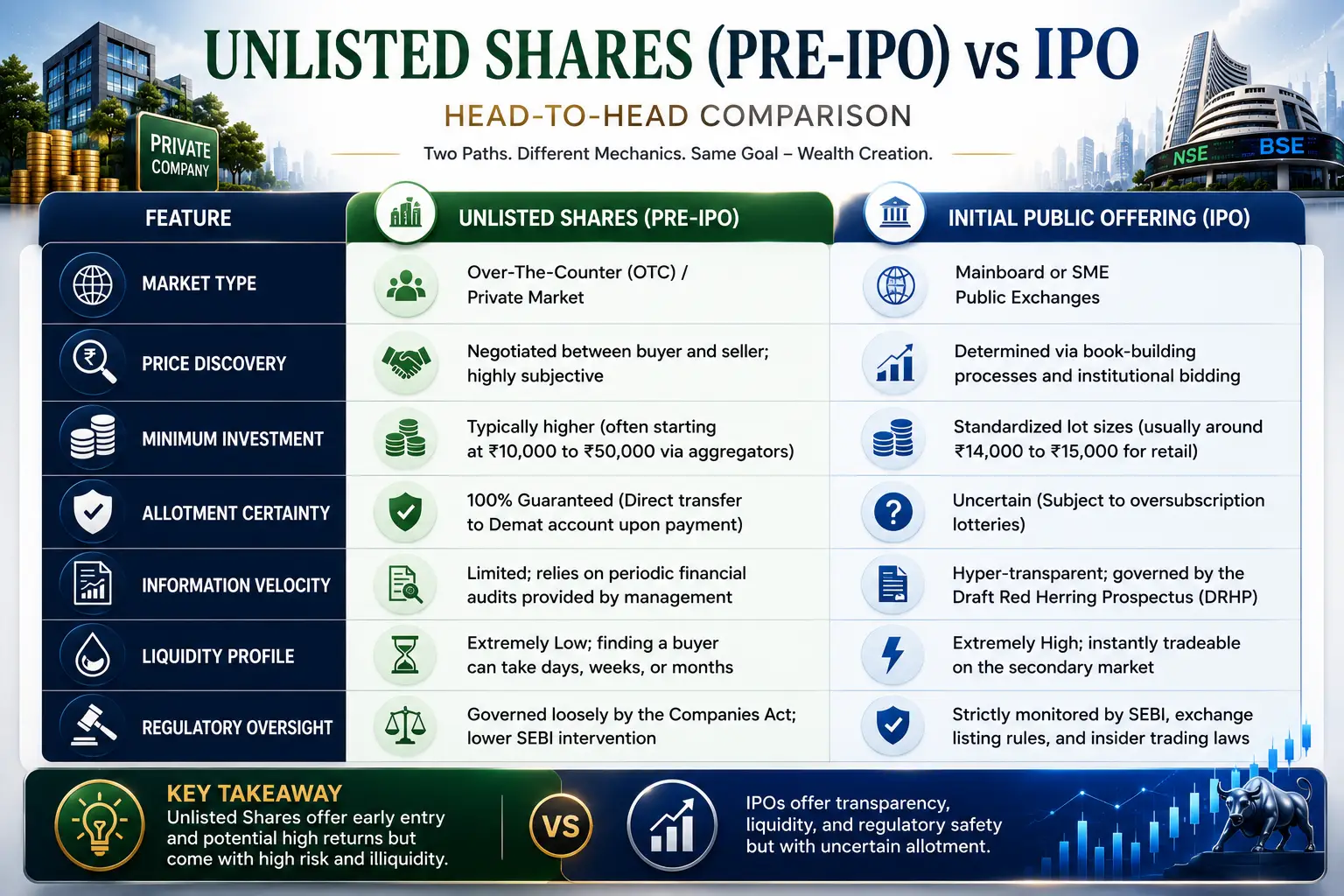
2. Head-to-Head Comparison
3. Risk Matrices and Hidden Vulnerabilities
Both avenues promise high returns, but their risk profiles are asymmetrical. Understanding these hidden structural risks is vital before deploying capital.
Risks Unique to Unlisted Shares
- Severe Illiquidity and Capital Lock-in: You cannot instantly liquidate unlisted shares if you face a personal financial emergency. Furthermore, SEBI mandates a 6-month lock-in period for pre-IPO shares after the company goes public. Your capital is effectively trapped during the volatile listing transition.
- Asymmetric Price Manipulation: Because there is no centralized order book, broker-dealers can artificially inflate or deflate prices based on manufactured scarcity.
- Counterparty and Settlement Risk: If buying through unauthorized channels, you run the risk of transferring funds without receiving the Demat credit. Always use reputable, vetted pre-IPO platforms that utilize escrow mechanisms.
- The "Zombie Share" Trap: A company may remain unlisted indefinitely if its macroeconomic conditions deteriorate. Your investment remains a paper asset with zero exit opportunities.
Risks Unique to IPOs
- The Allotment Lottery: In highly anticipated IPOs, retail tranches are routinely oversubscribed by 50x to 100x. The probability of getting an allotment is remarkably low, meaning your capital sits idle only to be refunded.
- Post-Listing Value Destruction: High hype does not guarantee performance. Many heavily oversubscribed IPOs list at a steep discount or crash shortly after listing if institutional investors dump their blocks.
- Shorter Due Diligence Windows: Retail investors typically get only 3 to 5 days to analyze the final prospectus, subscribe, and commit funds, leading to FOMO-driven (Fear Of Missing Out) decisions.
4. Return Dynamics and Valuation Realities
How money is made—and lost—in these asset classes depends heavily on valuation entry points.

The Valuation Asymmetry
- Unlisted Advantage: Investors buy at a fundamental discount because they are absorbing the liquidity risk. If an unlisted company is valued at a Price-to-Earnings (P/E) multiple of 20x privately, it may command a P/E of 40x upon entering the public market, handing massive multi-bagger returns to early investors.
- IPO Premium: By the time a company reaches an IPO, investment bankers price the issue to extract maximum value for the promoting founders. Retail investors often buy at peak valuations where the immediate upside might be capped.
Tax Treatment Realities (Indian Income Tax Act)
Taxation heavily impacts your net realized returns. Unlisted and listed equities are treated with stark differences:
- Unlisted Shares:
- Short-Term Capital Gains (STCG): Taxed at your applicable income tax slab rate if held for 24 months or less.
- Long-Term Capital Gains (LTCG): Taxed at 20% with indexation benefits if held for more than 24 months.
- Listed Shares (Post-IPO / Public Market):
- Short-Term Capital Gains (STCG): Taxed at a flat 20% if held for 12 months or less.
- Long-Term Capital Gains (LTCG): Taxed at 12.5% on gains exceeding ₹1.25 Lakhs per financial year, if held for more than 12 months (without indexation).
5. Decision Framework: Which Strategy Fits Your Portfolio?
To determine your optimal asset allocation, map your financial constraints against this definitive decision matrix:
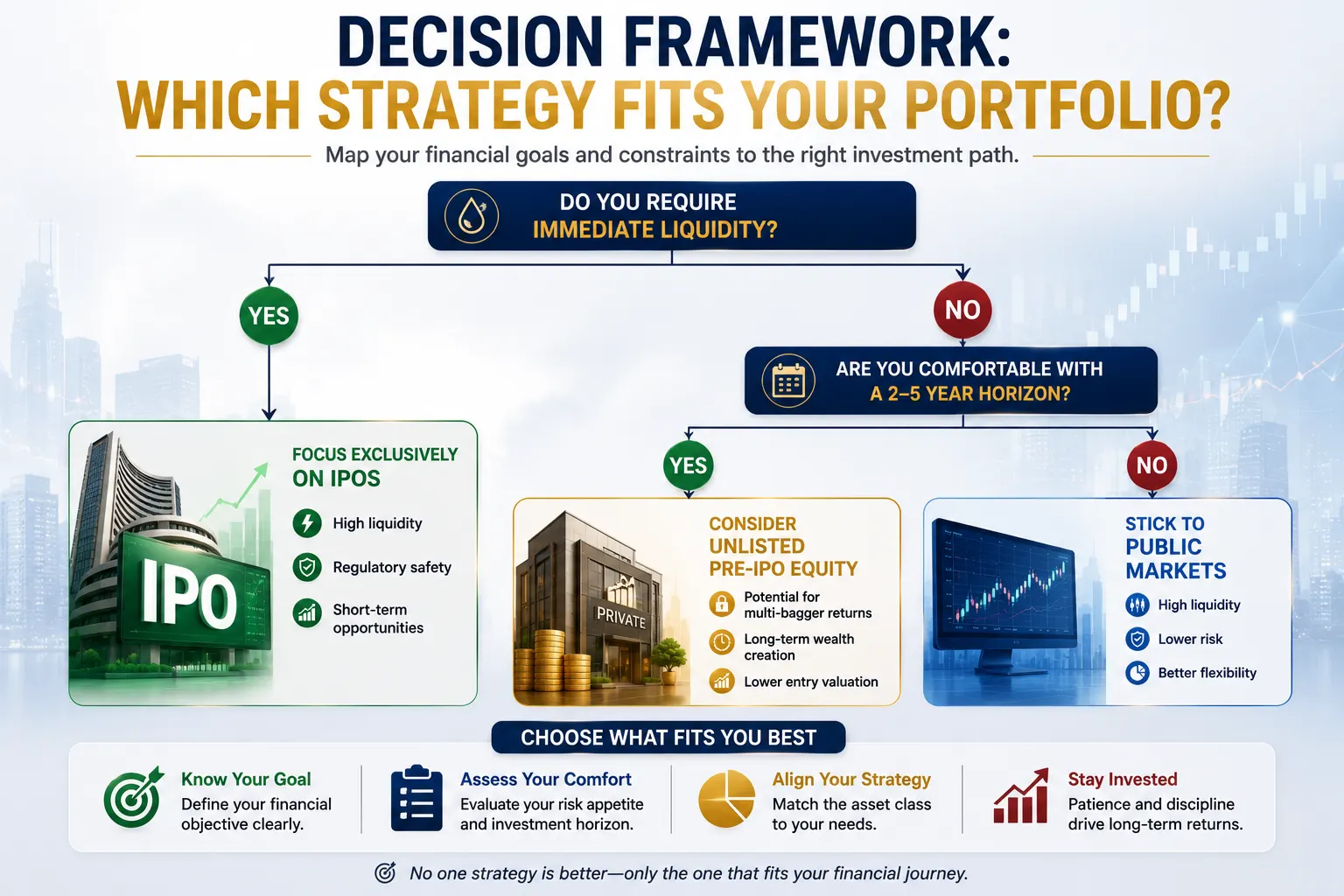
Choose Unlisted Shares If:
- You have a long-term investment horizon (3 to 5+ years) and do not need immediate access to cash.
- You want guaranteed ownership of a high-growth brand without dealing with IPO allotment lotteries.
- You possess the financial literacy to read deep audited financial balance sheets without relying on public analysts.
- Your net worth allows you to allocate high-risk capital that will not impact your daily livelihood if lost.
Choose IPOs If:
- You require absolute liquidity and want the option to exit your position in seconds via a mobile trading app.
- You prefer the safety net of extreme SEBI regulatory filters, standardized prospectuses, and institutional research reports.
- You are looking to capture short-term listing gains within a matter of weeks.
- You prefer straightforward capital gains tax structures with shorter holding windows for long-term status.

About the Author
Raj Santra is an Indian corporate business leader, fintech expert, technologist, and author. He specializes in bridging the gap between academic theory and real-world industrial corporate practices through educational technology and search automation.