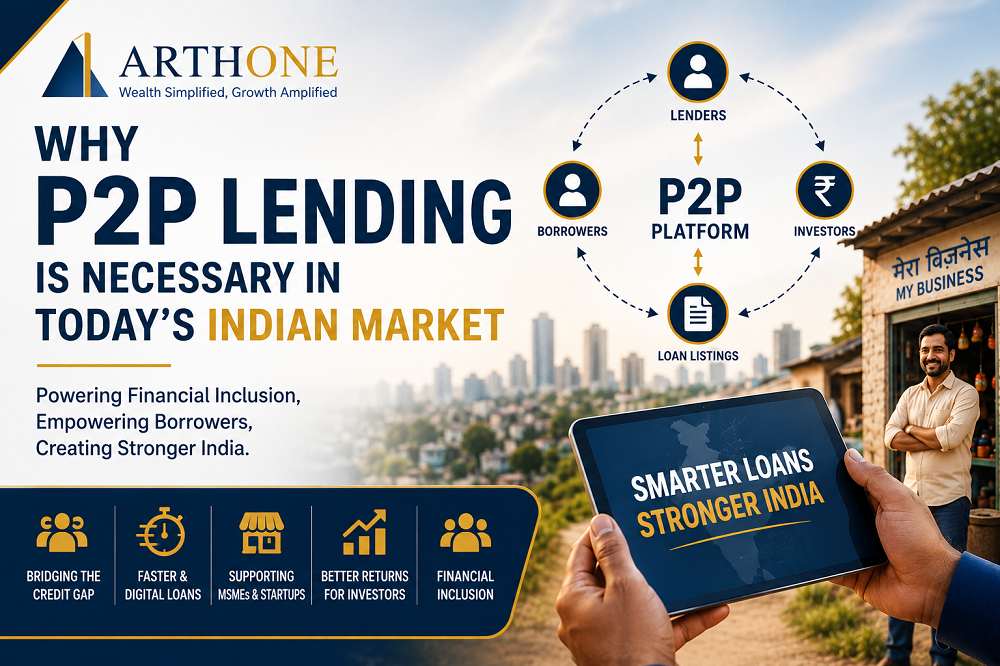
India is witnessing a rapid transformation in its financial ecosystem. With increasing digital penetration, evolving consumer behaviour, and a growing demand for quick and accessible credit, traditional banking systems alone are no longer sufficient to meet the financial needs of individuals and small businesses. In this environment, Peer-to-Peer (P2P) lending has emerged as a crucial alternative financing mechanism for the modern Indian market.
Understanding P2P Lending
Peer-to-Peer (P2P) lending is a technology-driven financial model that directly connects borrowers with lenders through online platforms. Instead of depending entirely on traditional banks or NBFCs, borrowers can access funds from individual investors, while lenders can earn competitive returns on their investments.
In India, P2P platforms are regulated by the Reserve Bank of India under the framework applicable to NBFC-P2P entities, ensuring transparency, compliance, and financial discipline in the sector.
Why P2P Lending is Necessary in India
1. Bridging the Credit Gap
A large portion of India’s population, especially small businesses, freelancers, gig workers, and first-time borrowers, still struggles to obtain formal credit from banks due to:
- Lack of credit history
- Insufficient collateral
- Complex documentation
- Long approval timelines
P2P lending platforms help bridge this financing gap by using technology-based credit assessment models and simplified digital on boarding processes.
This becomes especially important in a country where millions remain under banked despite rapid economic growth.

2. Faster and Digital Financing
Today’s consumers expect instant and digital financial solutions. Traditional loan approvals may take days or even weeks, whereas P2P platforms provide:
- Quick application processing
- Digital KYC verification
- Faster credit assessment
- Speedy disbursal of funds
In an era driven by fintech innovation and smartphone penetration, P2P lending aligns perfectly with India’s digital economy initiatives.
3. Supporting MSMEs and Startups
India’s MSME sector contributes significantly to employment and GDP but continues to face liquidity challenges. Many small enterprises are unable to secure working capital due to strict banking norms.
P2P lending offers:
- Easier access to short-term credit
- Flexible borrowing structures
- Reduced dependence on collateral-backed lending
For startups and small businesses, this alternative funding channel can be critical for sustaining operations and growth.
4. Better Returns for Investors
Traditional investment instruments such as fixed deposits often provide limited returns, particularly during low-interest-rate periods.
P2P lending allows investors to:
- Diversify their portfolios
- Earn potentially higher returns
- Participate directly in credit markets
For retail investors seeking alternative investment opportunities, P2P platforms create a modern asset class with controlled exposure and digital transparency.
5. Financial Inclusion
One of the strongest reasons for the rise of P2P lending in India is its contribution toward financial inclusion.
Many individuals in Tier-2 and Tier-3 cities:
- Lack access to formal banking channels
- Require small-ticket loans
- Need emergency or short-term financing
P2P platforms leverage technology to serve such segments efficiently, thereby supporting inclusive economic participation.
6. Technology-Driven Risk Assessment
Modern P2P platforms use:
- AI-based analytics
- Alternative credit scoring
- Banking transaction analysis
- Behavioral data assessment
This allows platforms to evaluate borrowers beyond conventional credit bureau scores, enabling access to credit for deserving applicants who may otherwise be rejected by banks.
7. Reducing Dependency on Traditional Banking
India’s growing economy requires diversified financing channels. Over-reliance on traditional banking institutions can slow down credit distribution.
P2P lending strengthens the financial ecosystem by:
- Expanding credit accessibility
- Encouraging fintech innovation
- Promoting competitive lending markets
This creates a more resilient and inclusive credit infrastructure for the country.
Regulatory Support and Market Growth
The Indian P2P industry has gained credibility due to regulatory oversight by the Reserve Bank of India. RBI regulations ensure:
- Registration of NBFC-P2P platforms
- Risk management standards
- Transparency in operations
- Protection of participant interests
With increasing fintech adoption and digital financial awareness, the P2P lending market in India is expected to grow substantially in the coming years.
Challenges That Need Attention
While P2P lending offers significant benefits, certain concerns remain:
- Credit default risks
- Investor awareness
- Data privacy concerns
- Regulatory compliance requirements
Therefore, responsible platform governance and informed participation are essential for sustainable industry growth.
Conclusion
P2P lending is no longer just an alternative financing option; it is becoming an essential component of India’s evolving financial ecosystem. By bridging the credit gap, empowering small businesses, enabling financial inclusion, and leveraging digital technology, P2P lending addresses several limitations of traditional banking systems.
As India continues its journey toward a digitally empowered economy, P2P lending has the potential to democratize credit access and create a more inclusive, efficient, and innovation-driven financial market.
About the Author
A qualified Company Secretary with 10+ years of experience in ROC compliances, trademark matters, and corporate regulatory advisory. Expertise in handling company incorporations, annual filings, compliance management, and legal documentation under corporate laws. Co-Founder of Arthone Fintech LLP, a wealth management firm focused on strategic financial and investment solutions. Dedicated to delivering practical, compliant, and growth-oriented business advisory services.