
Most people wait for a "big moment" to get serious about money: a fat year-end bonus, a major salary hike, or a windfall gain. The underlying assumption is simple: “Once I have enough money, I will start investing.”
But that is not how real wealth is built. It rarely starts with a large sum or a dramatic trigger. Instead, wealth happens quietly, built on small, repeated choices made month after month, long before a "big" amount ever exists.
Think about it this way: spending ₹100 to ₹200 daily on premium tea deliveries, an impulse late-night snack order, or an OTT subscription you forgot to cancel feels entirely harmless. Individually, these micro-spends don't impact your bank account today. Meanwhile, actual investing gets postponed: “I’ll start once I earn more.”
The truth is exactly the opposite. Redirecting these minor, unnoticed amounts into wealth-building financial instruments is how ordinary salaries turn into extraordinary financial independence over decades. This isn't a story of financial deprivation; it’s a story of strategic redirection.
1. The Foundation: Securing Your Safety Net First
Redirection only works if your money has a safe place to land. Before you put a single rupee into volatile market instruments, you must construct a robust safety net.
- The Emergency Fund: This should comfortably cover 6 months of your essential living expenses. It must sit somewhere liquid and boring—like a basic savings account or a high-quality liquid mutual fund—not in the stock market where it can fluctuate.
- Adequate Insurance Protection: Alongside your fund, you need comprehensive health insurance and a pure term life insurance policy (especially if you have financial dependents).
Think of this base as the structural foundation of your financial house. Without it, one unexpected hospital bill or job disruption can force you to liquidate your investments prematurely. A redemption midway is exactly what breaks compounding. Every rupee pulled out early doesn't just lose its own value; it destroys the geometric growth that would have built on top of it for the next 10, 20, or 30 years.
2. Navigating the Indian Investment Landscape
Once your foundation is rock-solid, you can strategically allocate your daily savings across different asset classes depending on your risk tolerance, return goals, and investment horizon.
Fixed Deposits (FDs): The Traditional Baseline
Fixed Deposits remain the most popular saving vehicle in India due to their guaranteed, predictable returns and extreme safety. However, they carry a hidden flaw: inflation risk. Because FD interest rates hover around 6% to 7.5% and the returns are fully taxable according to your income slab, their real, net-of-inflation return is often close to zero or even negative. FDs are excellent for capital preservation, but inefficient for aggressive wealth creation.
Choti SIPs (Small Mutual Fund Systematic Investment Plans)
A Systematic Investment Plan (SIP) allows you to automatically route as little as ₹100 or ₹500 a month into equity mutual funds. Equity SIPs expose your money to corporate India's growth engine. While they carry market risk over the short term, historically, long-term equity allocations in India have delivered compounding returns that outpace inflation by a wide margin. They also utilize rupee-cost averaging, meaning you automatically buy more mutual fund units when the market is low and fewer when it is high.
Non-Convertible Debentures (NCDs)
NCDs are debt instruments issued by corporations to raise long-term capital. They offer fixed interest rates (coupons) that are typically higher than traditional bank FDs—often ranging from 8% to 11% depending on the company's credit rating. While they provide predictable income, they come with a higher risk profile than FDs. If the issuing company faces a financial crisis, there is a risk of default. Therefore, sticking to highly rated NCDs (like AA or AAA ratings) is vital.
Peer-to-Peer (P2P) Lending
P2P lending is an alternative investment avenue facilitated by RBI-regulated digital platforms. It connects you directly as a lender to individual borrowers or small businesses. P2P platforms can offer attractive yields, frequently between 10% and 14% per annum. However, this high return comes with credit risk; if borrowers default on their loans, your principal can be at risk. Diversifying your lending amount across hundreds of micro-borrowers on the platform is critical to managing this volatility.
Direct vs. Regular Mutual Fund Plans: The Silent Leak
When setting up your SIPs, pay close attention to the version you choose. Regular plans include an ongoing commission paid out to a broker or distributor, which inflates the plan's Expense Ratio. Direct plans cut out the middleman, passing those savings directly to you. A difference of 0.75% to 1% in annual expenses may seem trivial on paper, but over a 25-to-30-year horizon, that tiny fee gap can eat away lakhs of rupees from your final corpus.
3. Side-by-Side: Asset Class Comparison
The table below outlines how these distinct financial pathways compare across crucial parameters: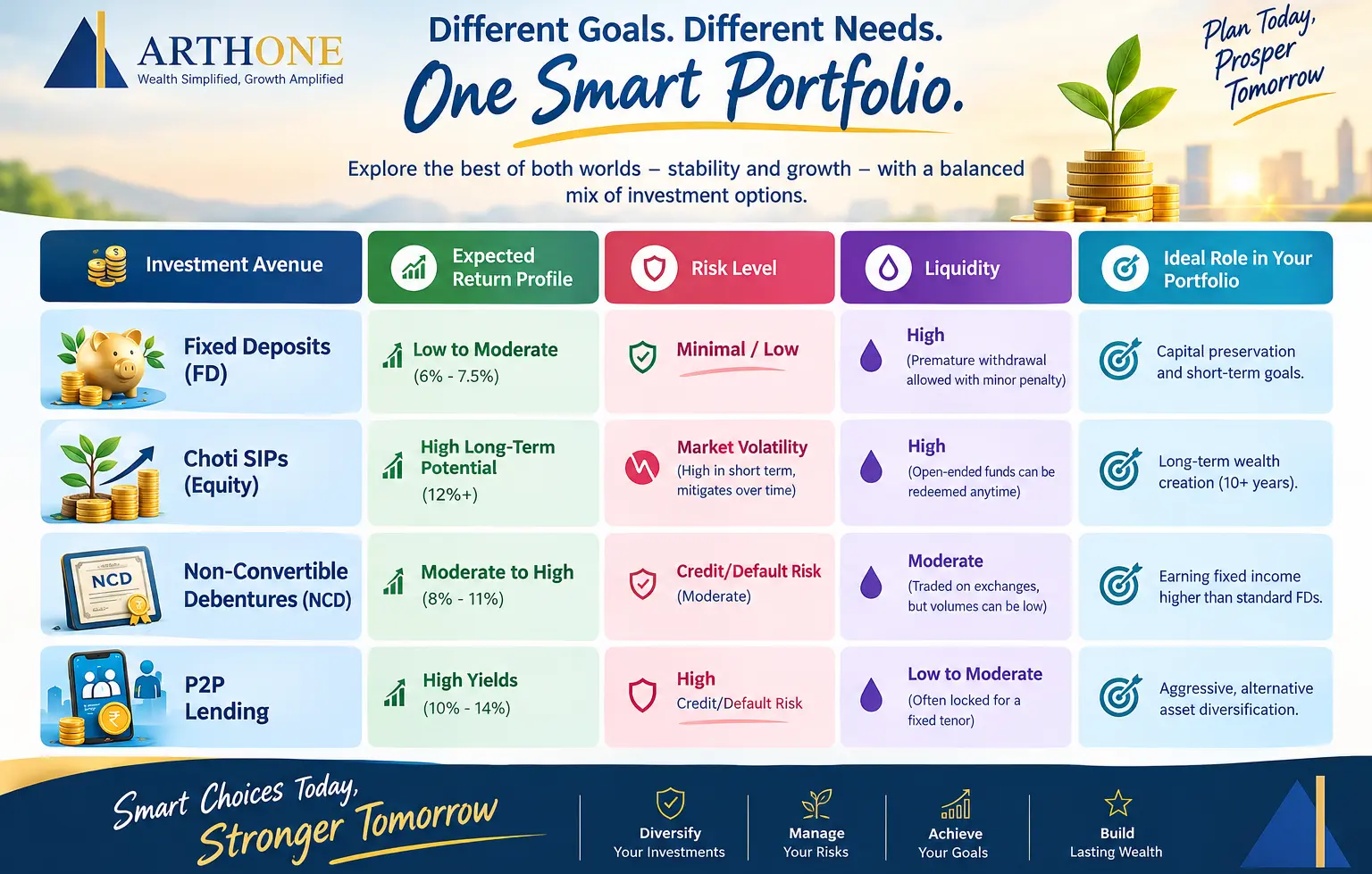 4. The Mathematical Reality: Starting Early vs. Investing More Later
To truly appreciate why small decisions matter today, look at the pure math of time versus money. Consider two friends, both planning for a retirement goal at age 60.
- Investor A starts early at age 30. They commit a modest ₹3,000 per month (just ₹100 a day) into an equity mutual fund SIP for 30 years. Their total out-of-pocket investment is ₹10.8 Lakhs.
- Investor B waits, procrastinates, and gets serious later at age 35. To make up for lost time, they invest a larger sum of ₹5,000 per month for the remaining 25 years. Their total out-of-pocket investment is ₹15 Lakhs—nearly 40% more money than Investor A.
Assuming an average long-term equity fund return of 12.62% per annum, let's see how their final corpuses compare:
Investor A’s smaller but longer-running investment grew to ₹1.04 Crore. Meanwhile, Investor B’s larger, delayed investment accumulated to ₹93.9 Lakhs.
Investor A put in significantly less money but ended up wealthier simply because they gave their money five additional years to compound. In the mechanics of wealth building, time is an aggressive multiplier, while the principal amount is merely an additive variable. You cannot easily out-earn a delayed start.
5. Automating Your Wealth Building on Autopilot
Human willpower is inherently unreliable. If your financial strategy relies on "investing whatever money is left at the end of the month," you will rarely find any surplus. A dynamic social calendar, an impulse shopping festival, or a spontaneous trip will continuously drain your accounts.
This is why automation beats motivation every single time:
- The Salary-Day Trigger: Coordinate your mutual fund SIP automated debit dates to fall immediately after your monthly salary hits your account. This executes the fundamental rule of personal finance: Pay yourself first. You redirect your wealth before you ever get the temptation to spend it.
- Micro-Investing Tools: Explore Indian fintech apps that offer automated digital transaction "round-ups." If you pay ₹260 for a cab ride via UPI, the app rounds the transaction up to ₹300 and automatically deploys the ₹40 difference into a pre-selected liquid or equity fund.
By automating these processes, investing evolves from a stressful choice you have to actively make every month into a quiet, background operational habit.
6. Plugging the Silent Money Leaks
Compounding is a double-edged sword: it works just as relentlessly against you if left unchecked. Just as small daily investments silently construct fortunes, recurring, unnoticed financial leaks erode your future net worth.
Commit to a quarterly 15-minute bank statement audit. Sit down every three months, scroll line-by-line through your digital transaction history, and actively eliminate the waste:
- Cancel overlapping OTT platform subscriptions you haven't watched in weeks.
- Track micro-UPI payments that feel like pocket change but accumulate to thousands of rupees monthly.
- Ensure credit card statements are paid in full automatically to eliminate late fees and exorbitant interest interest rates.
Your Action Step for Today
You don't need a massive inheritance or a six-figure monthly salary to achieve financial security in India. What you need is to start with an amount that feels completely manageable right now—even if it is just ₹100 a day—and give it the time it needs to grow.
Log into your preferred financial app today, set up a direct mutual fund equity SIP, and let time take care of the rest.

About the Author